
TikTok Content Ideas for Cafes and F&B in Malaysia (No Big Budget Needed)
You don't need a production crew to do well on TikTok as a cafe or restaurant. You need a phone, a few repeatable video formats, and the habit of posting. Here are 15 ideas your team can film between orders, with hooks in English and Bahasa Malaysia.
TikTok is where a lot of Malaysians now find their next makan spot. A late-night mamak, a new kopitiam in SS2, the cafe with the pandan croissant everyone is queueing for: people see it on their For You feed first, then look it up on Google Maps. For a small F&B business, that makes TikTok one of the cheapest ways to get in front of hungry, nearby people, and a natural part of your wider social media marketing.
The good news is that F&B content is naturally watchable. Food sizzles, drinks pour, regulars come back. This guide gives you 15 formats that work without a big budget, how to structure each video, and the rules you need to know about music and paid collaborations.
Why TikTok matters for F&B in Malaysia
According to DataReportal's Digital 2026 Malaysia report, TikTok's own advertising tools showed 30.7 million users aged 18 and above in Malaysia in late 2025, equal to 86.8% of the country's internet users. That's an ad-audience figure, not a count of unique people, but it shows how many Malaysians you can reach on the platform.
For food businesses, TikTok works a bit like a menu, a review site and a word-of-mouth channel at once. People save videos of places they want to try, send them to friends, and use them to decide where to eat this weekend.
Before you film: set up your account properly
A few minutes of setup saves trouble later.
- Use a Business Account. TikTok says Business Accounts are for anyone whose main goal is to promote a business. They come with analytics, the Business Suite and a website link on your profile.
- Only use commercially cleared music. This catches a lot of F&B owners out. Business Accounts can't use TikTok's general music library, because those songs are cleared for personal use only. Use the Commercial Music Library instead, which TikTok says is pre-cleared and free for businesses. This applies to normal posts, Duets and Stitches too.
- Tag your location. When you post, you can add a location so people can tap through to your place. Make sure your outlet name and address match what's on your Google Business Profile, so customers (and search engines) see the same details everywhere.
- Fill in your bio. Area, opening hours or "open daily", and how to order or book (WhatsApp, delivery app, walk-in).
The simple structure behind most good TikToks
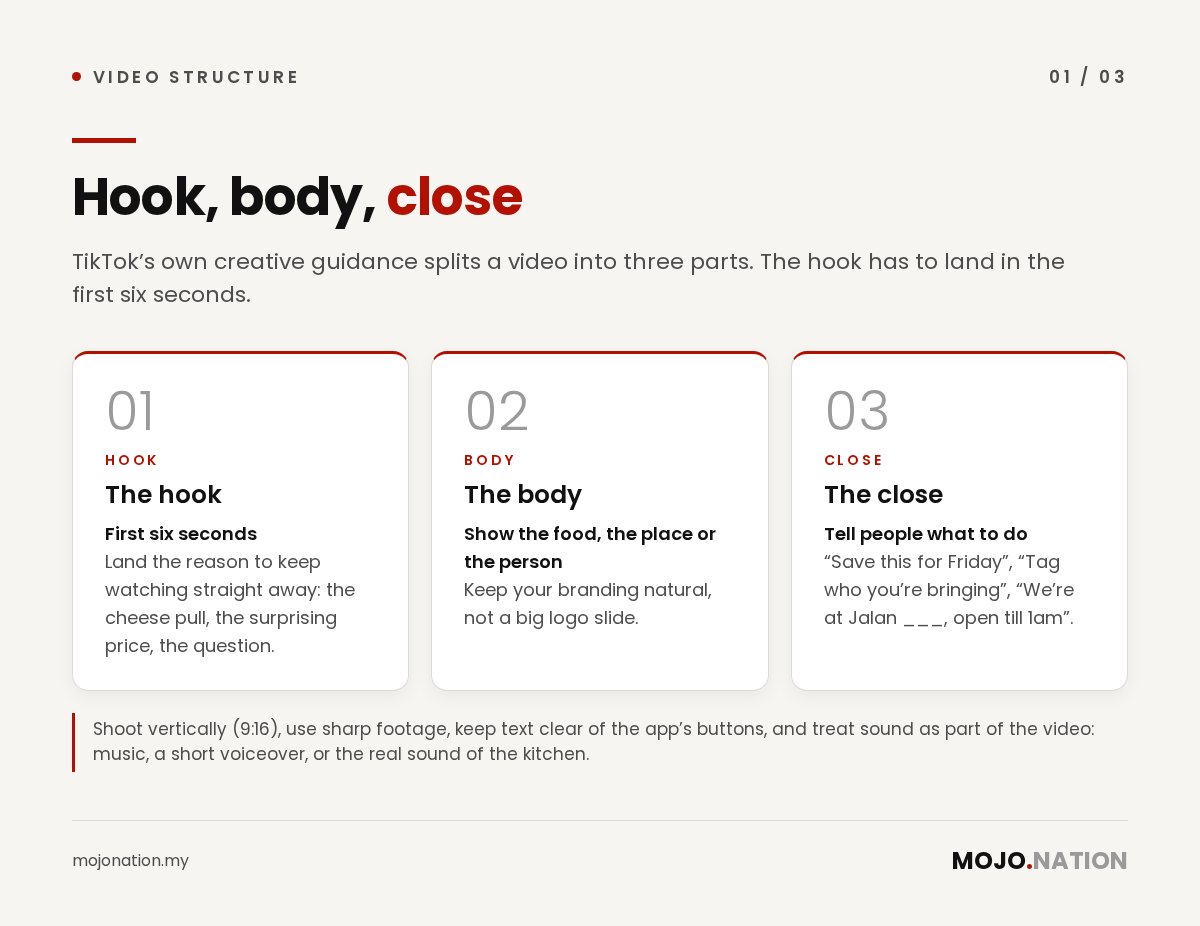
TikTok's own creative guidance splits a video into three parts:
- The hook (first six seconds). Land the reason to keep watching straight away: the cheese pull, the surprising price, the question.
- The body. Show the food, the place or the person. Keep your branding natural, not a big logo slide.
- The close. Tell people what to do: "Save this for Friday", "Tag who you're bringing", "We're at Jalan ___, open till 1am".
TikTok also recommends shooting vertically (9:16), using sharp footage, keeping text clear of the app's buttons, and treating sound as part of the video: music, a short voiceover, or the real sound of the kitchen.
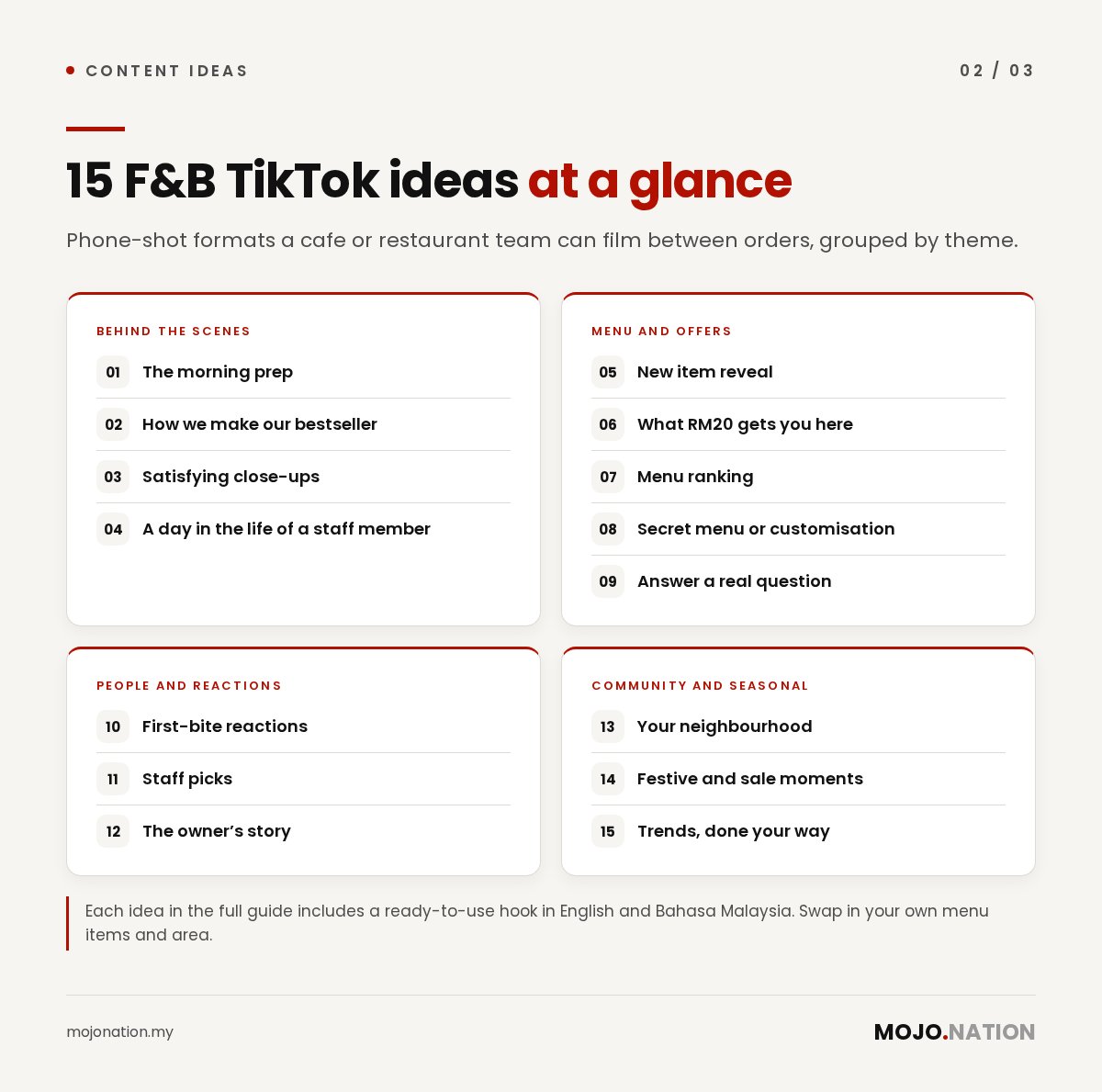
15 TikTok video ideas for cafes and restaurants
Each idea includes an example hook in English and BM. Swap in your own menu items and area.
Behind the scenes
1. The morning prep. Doors closed, lights on, dough rolled, sambal cooked. Real prep shows the effort behind the food.
- EN: "What 6am looks like before we open"
- BM: "Ini yang jadi pukul 6 pagi sebelum kedai buka"
2. How we make our bestseller. One signature item from start to finish in under 30 seconds.
- EN: "Why our nasi lemak sells out by 11am"
- BM: "Kenapa nasi lemak kami habis sebelum pukul 11"
3. Satisfying close-ups. Latte art, wok hei, a knife through a cake. Let the real sound carry it.
- EN: "Turn your sound on for this one"
- BM: "Buka bunyi untuk yang ni"
4. A day in the life of a staff member. The barista, the cook, the uncle who's been there 20 years. People come back for people.
- EN: "Meet the person who's made every roti here since 2009"
- BM: "Kenalkan orang yang buat semua roti di sini sejak 2009"
Menu and offers
5. New item reveal. Tease it, then show it. Post a few days before launch, then again on launch day.
- EN: "We've been testing this for a month. Launching Friday."
- BM: "Dah sebulan kami cuba resipi ni. Lancar Jumaat ni."
6. "What RM20 gets you here." Honest value content does well in Malaysia. Use your real prices.
- EN: "What RM20 gets you at our cafe"
- BM: "Apa yang anda dapat dengan RM20 di kafe kami"
7. Menu ranking. The team ranks five items, or you rank your own bestsellers. Invite people to disagree in the comments.
- EN: "Ranking our menu from 'good' to 'order this every time'"
- BM: "Kami ranking menu sendiri, setuju tak?"
8. Secret menu or customisation. An off-menu combo or a "how regulars order it" tip.
- EN: "The order only our regulars know about"
- BM: "Menu rahsia yang pelanggan tetap je tahu"
9. Answer a real question. Reply to a comment with a video: halal status, parking, whether you take bookings, the spice level.
- EN: "Is it really that spicy? Let's test it."
- BM: "Betul ke pedas sangat? Jom cuba."
People and reactions
10. First-bite reactions. With customers' permission, film genuine first reactions. Ask before you film, every time.
- EN: "Their first time trying our durian cendol"
- BM: "Kali pertama dia cuba cendol durian kami"
11. Staff picks. Each team member names their favourite item and why. Simple, friendly and easy to repeat weekly.
- EN: "What our staff actually order on their break"
- BM: "Apa staf kami order masa rehat"
12. The owner's story. Why you opened, what went wrong in year one, what you're proud of. Short, honest and unpolished usually works best.
- EN: "I quit my job to open this cafe. Here's year one."
- BM: "Saya berhenti kerja untuk buka kafe ni. Ini tahun pertama saya."
Community and seasonal
13. Your neighbourhood. Show how to find you, where to park, and what's nearby. It helps people who've never been.
- EN: "How to find us (and where to park) in Bangsar"
- BM: "Cara nak cari kami (dan tempat parking) di Bangsar"
14. Festive and sale moments. CNY, Raya, Deepavali, Christmas and the 11.11 and 12.12 sale days are all reasons to post a special, a set menu or a gift box.
- EN: "Our 12.12 set, only this weekend"
- BM: "Set istimewa 12.12, hujung minggu ni je"
15. Trends, done your way. Use a trending format or a Commercial Music Library sound that fits your brand, and give it a food twist. Skip trends that don't suit you.
- EN: "POV: you ordered the 'small' portion here"
- BM: "POV: anda order saiz 'kecil' di sini"
Turning one shoot into a week of posts
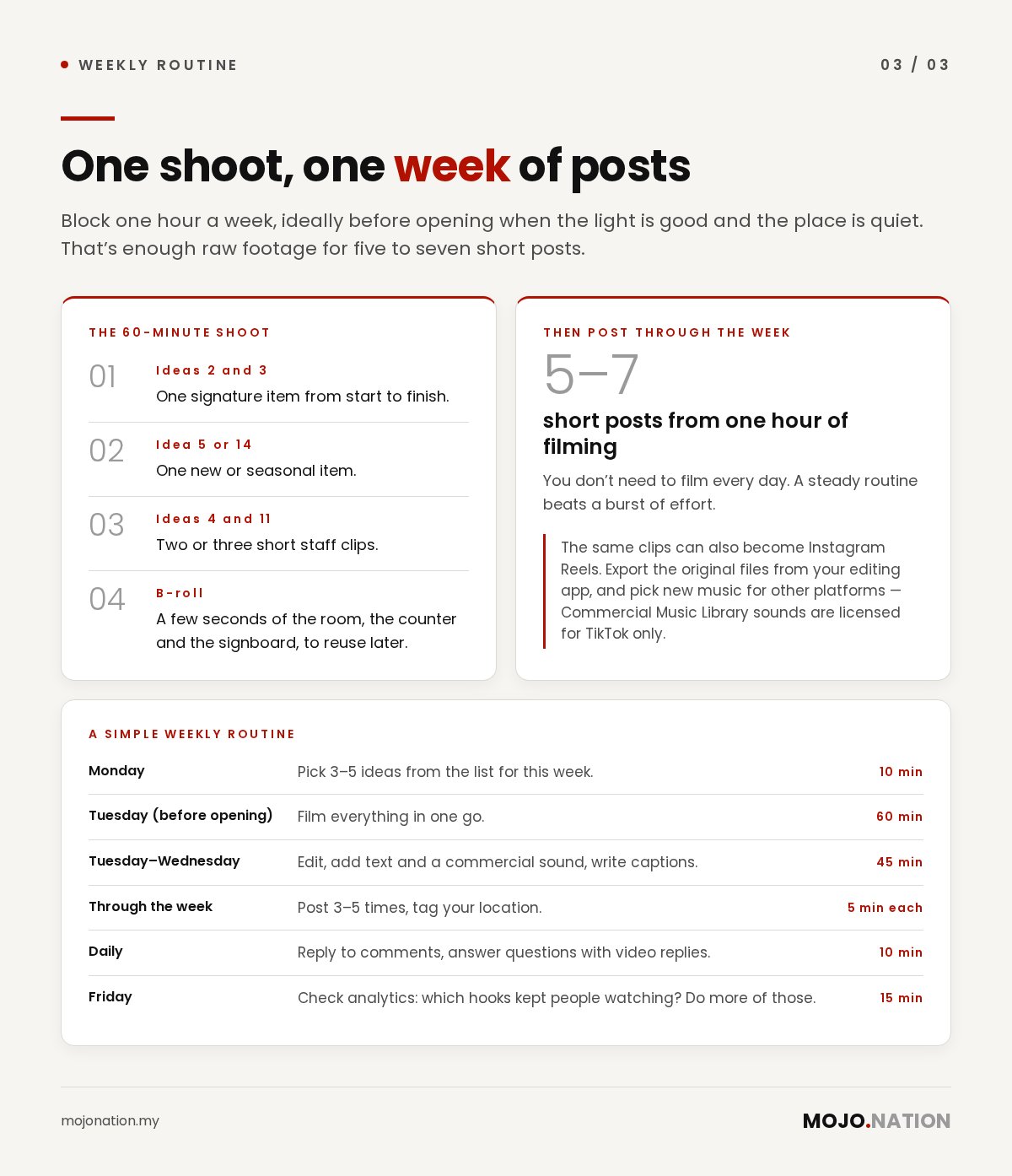
You don't need to film every day. Block one hour a week, ideally before opening when the light is good and the place is quiet, and film:
- one signature item from start to finish (ideas 2 and 3),
- one new or seasonal item (idea 5 or 14),
- two or three short staff clips (ideas 4 and 11),
- a few seconds of the room, the counter and the signboard to reuse as b-roll.
That's enough raw footage for five to seven short posts, plus Instagram Reels from the same clips (export the original clips from your editing app rather than re-uploading the watermarked TikTok download, and remember that Commercial Music Library sounds are licensed for use on TikTok only, so pick new music for other platforms).
Working with food creators (and disclosing it)
Food creators and smaller micro-KOLs can bring in people who'd never have found you otherwise.
What this looks like in practice
The Gust, a Japanese fusion restaurant at Core Residence @ TRX in Kuala Lumpur, is a useful example of how a real dining room puts this into practice. It serves à la carte, omakase and yakitori, so its social content has to show the food, explain the different ways to dine, and keep the restaurant in people's minds between visits. Mojo Nation creates and publishes The Gust's own posts on a regular schedule, and partners with food and lifestyle creators who visit and share their experience. The two work together: creators introduce the restaurant to new diners, and the restaurant's account gives them more reasons to visit.
A few ground rules:
- Brief them, but let them sound like themselves. Share your key dishes, your opening hours and anything to avoid, then leave the style to them.
- Make disclosure part of the deal. TikTok requires the content disclosure setting to be turned on whenever a post promotes a brand, product or service. A creator posting for you is labelled "Paid partnership", and your own promotional posts are labelled "Promotional content". In Malaysia, the Content Code 2022 also says paid or reciprocal reviews and endorsements should be clearly disclosed. To be safe, treat a free meal in exchange for a post as a reciprocal arrangement and disclose it too.
- Ask for usage rights up front if you want to repost their video on your own account or run it as an ad.
A simple weekly TikTok routine for a small F&B team
| Day | Task | Time |
|---|---|---|
| Monday | Pick 3-5 ideas from the list for this week | 10 min |
| Tuesday (before opening) | Film everything in one go | 60 min |
| Tuesday-Wednesday | Edit, add text and a commercial sound, write captions | 45 min |
| Through the week | Post 3-5 times, tag your location | 5 min each |
| Daily | Reply to comments, answer questions with video replies | 10 min |
| Friday | Check analytics: which hooks kept people watching? Do more of those. | 15 min |
Common mistakes
- Using popular songs on a Business Account. Stick to the Commercial Music Library.
- A slow start. If nothing happens in the first few seconds, people scroll. Open on the food, not the logo.
- Making every video an ad. Mix in the people, the prep and the fun. Promote offers some of the time, not all the time.
- Posting once, then disappearing. A steady routine beats a burst of effort.
- Forgetting the basics off TikTok. People who love your video will check Google Maps next. Make sure your hours, photos and reviews there are up to date.
- Skipping disclosure on creator collabs. It protects your brand and the creator.
FAQ
How often should a cafe or restaurant post on TikTok?
There's no official number. Pick a pace your team can keep, such as three to five posts a week, and stick to it. Consistency matters more than volume.
Do I need professional equipment?
No. A recent phone, natural light and a cheap clip-on mic are enough. TikTok's own guidance favours native, phone-style video shot vertically in 9:16.
Can I use any trending song in my cafe's TikToks?
Not on a Business Account. Business Accounts can only use sounds from TikTok's Commercial Music Library, which is pre-cleared for commercial use.
Should I post in English, BM or Chinese?
Post in the language your customers use. Many Malaysian F&B accounts mix languages in captions and on-screen text, which also helps people searching in each language find you.
Do I have to disclose free meals given to food creators?
Yes. TikTok requires the content disclosure setting on posts that promote a brand, product or service, and the Content Code 2022 says paid or reciprocal reviews should be clearly disclosed.
Does TikTok help my business show up on Google or AI assistants?
Not directly, but it helps people discover you and search for your name. Keeping your Google Business Profile, website and reviews consistent is what helps Google and AI assistants describe your business accurately.
Want help turning this into a plan?
Mojo Nation helps Malaysian F&B and other local businesses plan, film and post content that brings people through the door, alongside search and AI visibility. If you'd like a second pair of eyes on your TikTok and Google presence, start with a free audit.
Next: make sure people can find you on Google Maps.
How Mojo Nation writes our guides: researched with AI tools, written and fact-checked by our team, and reviewed before publishing. Last updated: 11 November 2026.
Get a free audit
Free review of your social media, website and AI search visibility. No obligation.
More guides
TikTok vs Instagram Reels for Business in Malaysia: Which Should You Use?
Compare audience, content effort and sales fit, then pick which platform to start with, and how to reuse one video on both.
Read →
Year-End Marketing Health Check: 30 Minutes to Prepare Your SME for 2027
A 30-minute year-end marketing check for Malaysian SMEs: website, Google profile, search, AI assistants, social and enquiries, plus 2027 dates.
Read →
Local SEO for Malaysian Cafes and Restaurants: How to Show Up for "Near Me" Searches
A practical local SEO guide for Malaysian cafes and restaurants: Google Business Profile, menu, reviews, outlet pages and monthly checks, using Google's own rules.
Read →
Google Business Profile for Malaysian SMEs: A Complete Setup Checklist
A step-by-step checklist to set up and verify your Google Business Profile: name, categories, hours, photos, reviews and updates.
Read →
Google AI Overviews: What Malaysian Business Owners Need to Know
What AI Overviews are, how Google picks the websites it shows, and six practical steps to become a source it cites.
Read →
11.11 and 12.12 content ideas for Malaysian SMEs
TikTok and Instagram ideas, creator collabs and live timing for cafes, salons and shops, without discounting everything.
Read →
How to work with micro-KOLs in Malaysia: a step-by-step guide for SMEs
Find, brief and work with smaller creators, get disclosure right, and measure what matters. Includes our trial and retainer prices.
Read →
How to get your business recommended by ChatGPT
Practical, honest steps to improve the chances AI assistants like ChatGPT recommend your business.
Read →
SEO vs KOL marketing: why you need both
SEO captures demand; KOLs create it. How combining the two gives Malaysian brands compounding growth.
Read →
What is AI search visibility and why Malaysian SMEs should care
More customers ask ChatGPT, Gemini and Perplexity for recommendations. Here’s what AI search visibility means and how to start.
Read →